From Campaigns to Partnerships
Singapore’s approach to entertainment-driven marketing has evolved beyond individual campaigns into a sophisticated partnership economy, where long-term collaborations with global entertainment brands create sustained marketing platforms rather than one-off activations. This strategic shift represents a maturation of the city-state’s creative advertising industry—moving from transactional campaign execution to relationship-based brand building that leverages entertainment IP, artist networks, and cultural moments on an ongoing basis.
The Universal Music Partnership
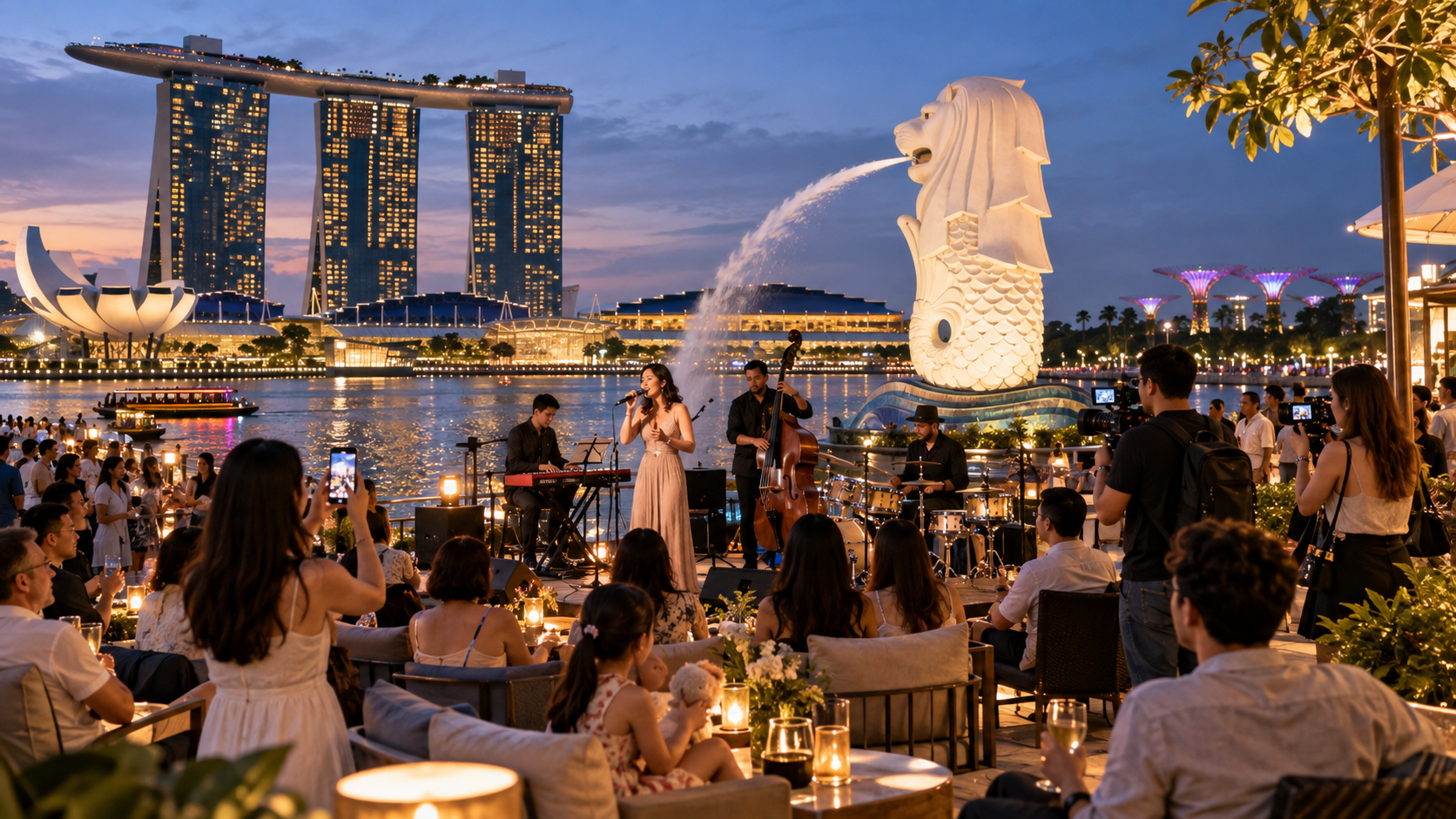
The most significant recent development in this space is the three-year Memorandum of Understanding between the Singapore Tourism Board and Universal Music Singapore, signed in May 2026. The partnership draws on UMSG’s network of international artistes, market insights, and global media channels to create a platform that introduces Singapore to new audiences through music.
The MoU explicitly aims to create “truly exclusive, Singapore-only experiences within Southeast Asia, such as intimate fan events at iconic locations,” according to Kenneth Lim, Assistant Chief Executive of STB’s Marketing Group. This emphasis on exclusivity is strategically important: in a competitive regional tourism market, offering experiences that cannot be replicated elsewhere provides a compelling differentiator.
The partnership builds on a track record of successful artiste collaborations. Nick Jonas’s appearance at Singapore Art Week, OneRepublic’s social content exploring their track “Singapore,” and Billie Eilish’s live performance at Gardens by the Bay all demonstrated the power of authentic, artiste-led storytelling to inspire travel. The multi-year structure of the UMSG deal suggests STB is institutionalising these successes rather than treating them as isolated opportunities.
The Merlion as a Recurring Entertainment Property
The Singapore Superfans campaign, now in its third edition, exemplifies how a destination marketing asset can be developed as an ongoing entertainment property rather than a static brand icon. The 2026 iteration transformed the Merlion into a self-aware rock star protagonist, complete with a launch film directed by Peggy Goh and music by Bumblebeat.
Crucially, the campaign was designed for continuity. The #MerlionMadeMeDoIt challenge invites ongoing audience participation across Instagram, Red Note, and TikTok, with creator-led social challenges in multiple markets. The campaign’s integration with Scoot—Singapore’s low-cost carrier—provides a conversion mechanism through limited-time flight sales, connecting entertainment engagement directly to travel bookings.
This multi-edition approach allows STB to build equity in the Merlion as an entertainment character over time, rather than resetting the creative strategy with each campaign cycle. It’s a model that borrows from franchise entertainment, where characters and narratives accumulate meaning across multiple instalments.
The Multi-Sector Partnership Ecosystem
Singapore’s partnership economy extends across sectors and brand categories. The Fairmont Singapore Baby Shark activation involved collaboration between the hotel, the Singapore Tourism Board, and The Pinkfong Company—a three-way partnership that combined hospitality expertise, destination marketing reach, and global entertainment IP. Similarly, the CRYBABY Oceanarium activation brought together POP MART, Resorts World Sentosa, and STB.
These multi-stakeholder collaborations create value that no single partner could achieve independently. The hotel provides physical infrastructure and hospitality expertise; the tourism board provides marketing reach and destination credibility; the entertainment brand provides audience recognition and creative assets. The result is an experience that feels genuinely integrated rather than cobbled together from disparate components.
The Strategic Logic of Long-Term Commitment
The shift toward multi-year partnerships reflects a broader understanding within Singapore’s advertising industry: entertainment-driven marketing works best when it’s given time to develop. One-off activations generate spikes in attention, but sustained partnerships build cumulative brand equity. The UMSG deal, the multi-edition Merlion campaign, and the repeat collaborations with entertainment IP holders all point in the same direction—toward a partnership economy where the most valuable marketing assets are relationships, not campaigns.
For brands and agencies looking to Singapore as a model, the lesson is clear: entertainment as marketing strategy isn’t a tactic to be deployed and discarded. It’s an infrastructure to be built, maintained, and grown over time.