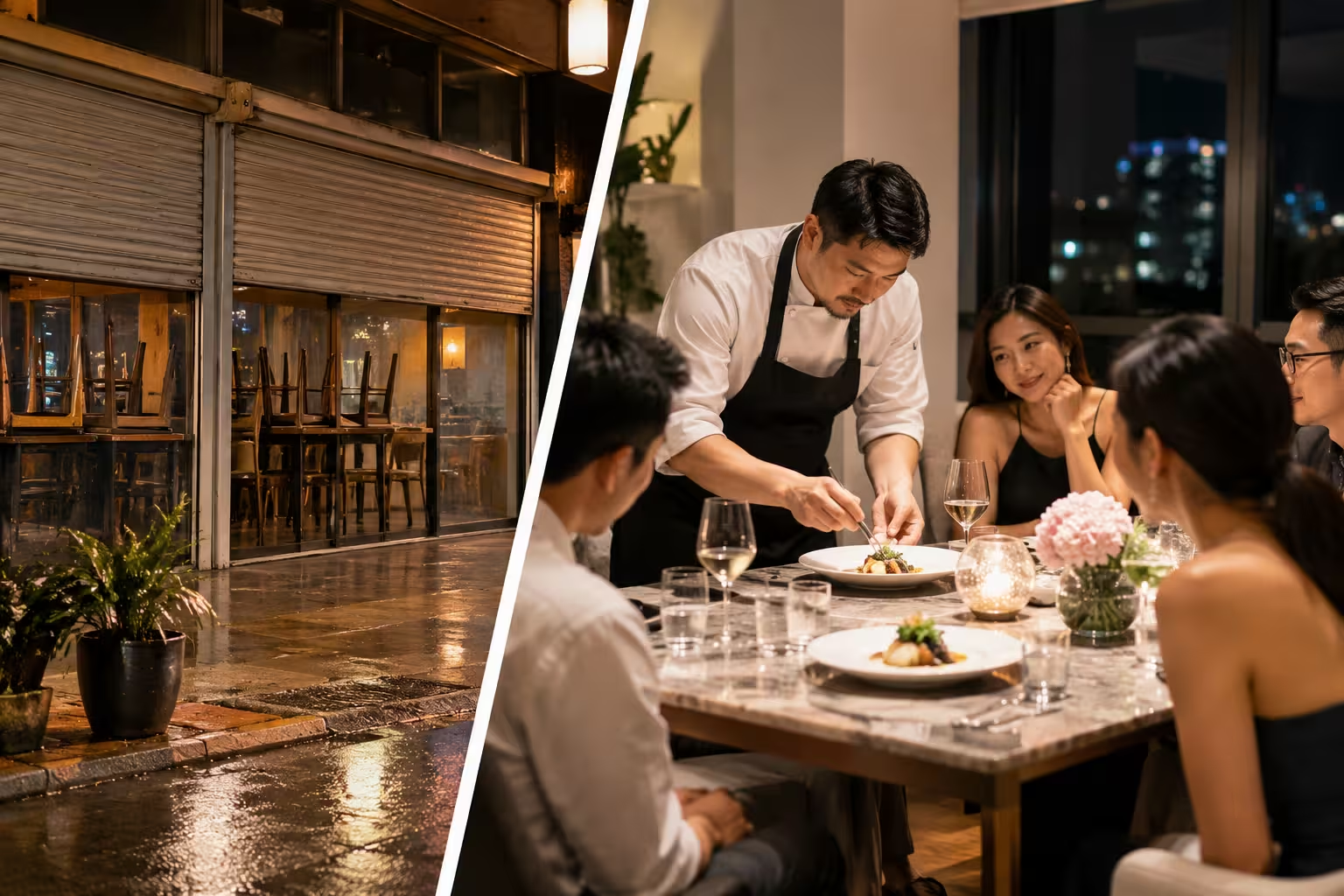
Two Markets, Opposite Trajectories
Singapore’s commercial F&B sector is in distress. More than 3,000 outlets closed in 2024, the highest annual total in nearly two decades, and closures continued through 2025 at roughly 300 per month . The Restaurant Association of Singapore has called for rental caps, foreign worker levy removal, and higher wage co-funding to prevent further attrition . DBS forecasts F&B sales excluding hawkers to fall 1.2% in 2026 to approximately $11.8 billion .
Against this backdrop, private home dining is expanding. New concepts launch monthly. Waitlists lengthen. Chefs with Michelin pedigrees choose residential kitchens over commercial ones.
The Cost Structure That Favours Living Rooms
The private dining advantage is structural, not merely cultural. A home-based F&B operator avoids commercial rent—the single largest fixed cost for restaurants in Singapore, where lease renewals in prime locations routinely involve material increases . The operator avoids foreign worker quotas and levies, since HBB rules prohibit employing staff outside the household . There is no liquor licence requirement unless alcohol is supplied, in which case a police licence is needed but not a restaurant-grade one .
The trade-off is scale. A restaurant serving 60 covers per night at $80 average generates $4,800 in revenue. A private dining chef serving eight at $170 generates $1,360—but with near-zero rent, no service staff, and no inventory waste beyond what is pre-ordered for confirmed guests.
The Talent Migration
The more consequential shift may be reputational. When chefs who have worked at Les Amis, Quince, and O’ by Claude Le Tohic choose to operate from HDB flats and condominiums, the hierarchy of prestige in Singapore’s culinary industry begins to flatten . Private dining is no longer a stepping stone or a side project. It is a destination.
This migration also drains talent from the restaurant sector, which already faces persistent manpower shortages . Every chef who leaves a commercial kitchen for a home kitchen removes a trained professional from an industry that cannot easily replace them.
The Regulatory Question Ahead
The current HBB framework was designed for small-scale, low-risk activities—home bakers, tuition teachers, freelance consultants . It was not designed for $235-per-head omakase dinners with waitlists measured in months. As private dining grows in visibility and price point, the question of whether the regulatory lightness that enabled it can persist becomes harder to avoid.
For now, the sector operates in a gap between residential permission and commercial ambition. The chefs, the diners, and the regulators all know it.