Singapore may not be the first Asian destination that international travelers associate with art. Cities such as Tokyo, Seoul, Hong Kong, and Bangkok often dominate cultural travel conversations.
Yet Singapore has developed a distinctive advantage: visitors can move quickly between major Southeast Asian collections, experimental contemporary spaces, commercial galleries, historic architecture, and professional performing arts venues.
For art-focused travelers in 2026, this concentration makes the city unusually accessible without making its cultural story simple.
A Major Gateway to Southeast Asian Art
National Gallery Singapore provides the clearest reason to take the city seriously as an art destination.
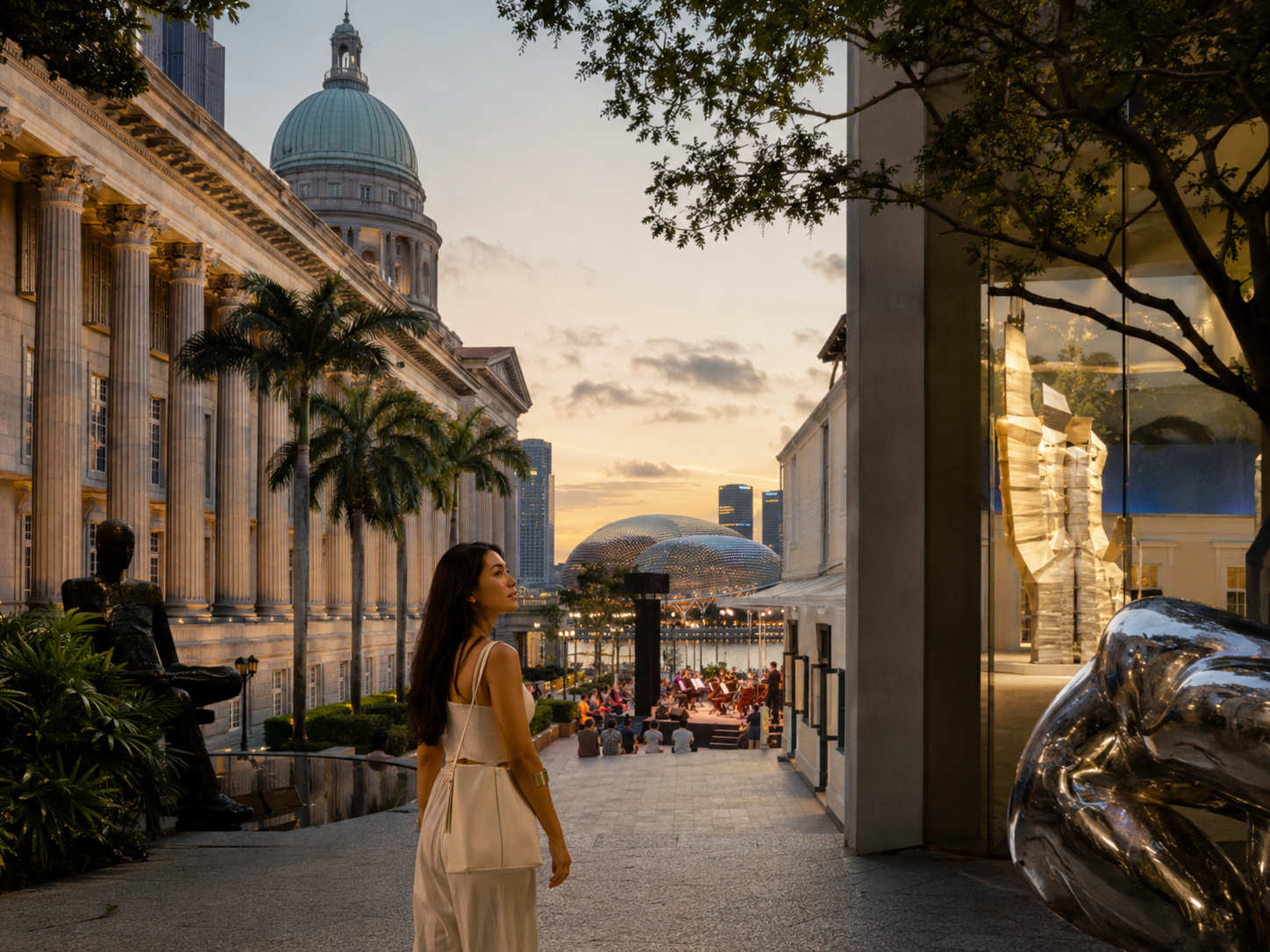
Located in the former Supreme Court and City Hall buildings, the institution brings together visual culture and national history. Its emphasis on Singaporean and Southeast Asian modern art is particularly valuable for visitors whose understanding of twentieth-century art has been shaped mainly by Western museums.
The works can open wider questions about colonialism, independence, modernization, national identity, and the social consequences of rapid development.
Travelers preparing a 2026 visit can review exhibition and visitor information through the official National Gallery Singapore website.
The gallery’s importance is not simply based on scale. Its real strength is context: it encourages visitors to see Singapore as part of an interconnected Southeast Asian cultural history.
Contemporary Art Reveals a Changing City
Singapore Art Museum and New Creative Forms
While historical collections explain where the region has come from, contemporary institutions examine the pressures shaping the present.
Singapore Art Museum is an important part of this conversation. Contemporary artists may work with video, installation, performance, sound, digital media, and socially engaged projects.
These formats are well suited to questions that matter in Singapore and across the wider region, including environmental change, technology, memory, migration, and the tensions created by urban growth.
The setting at Tanjong Pagar Distripark adds another layer. A former industrial environment used for cultural activity reflects the changing relationship between cities and creative space.
Galleries Bring Visitors Closer to the Art Ecosystem
Gillman Barracks demonstrates that Singapore’s art scene extends beyond large public institutions.
Gallery environments can offer closer contact with specific artists, curatorial ideas, and the commercial structures that influence which artworks reach collectors and international audiences.
This is particularly relevant in Singapore, a city positioned between Southeast Asian cultural production and global networks of finance and trade.
For travelers, the experience can feel more specialized and less predictable than visiting a major museum. However, current exhibition calendars and opening hours should always be checked in advance.
Performance Shows Culture as a Living Practice
A complete art journey also needs music, theater, or dance.
Esplanade – Theatres on the Bay plays a major role in presenting both international and regional performance. Its cultural value lies in the range of artistic languages that can appear on its stages.
Singapore’s multicultural identity cannot be fully understood through paintings and museum objects alone. Performance allows traditions to evolve in front of an audience.
A classical concert, contemporary play, dance production, or culturally rooted music program can reveal how heritage continues to change rather than remaining frozen in the past.
Singapore’s Real Advantage for Art Travelers in 2026
What makes Singapore compelling is not one museum or one famous exhibition. It is the ability to experience different parts of the cultural ecosystem within a relatively compact city.
A traveler can study modern Southeast Asian art in a historic civic building, explore experimental work in an industrial district, visit commercial galleries, and end the day with a live performance.
That combination gives Singapore a powerful position in cultural tourism. In 2026, the city deserves attention not because it imitates older art capitals, but because it offers its own model: highly connected, regionally focused, architecturally layered, and increasingly open to artistic experimentation.