The Numbers Behind the Boom
Singapore’s live entertainment market was valued at USD 1.29 billion in 2025 and is forecast to reach USD 2.08 billion by 2034, growing at a compound annual growth rate of 5.47 percent during the 2026–2034 period. That is not a speculative projection. It is grounded in observable demand: sold-out stadium tours, surging hotel bookings, and a 2026 events calendar that organizers describe as filling up rapidly, with some events booked as far as two years in advance.
The Concert Calendar as Economic Infrastructure
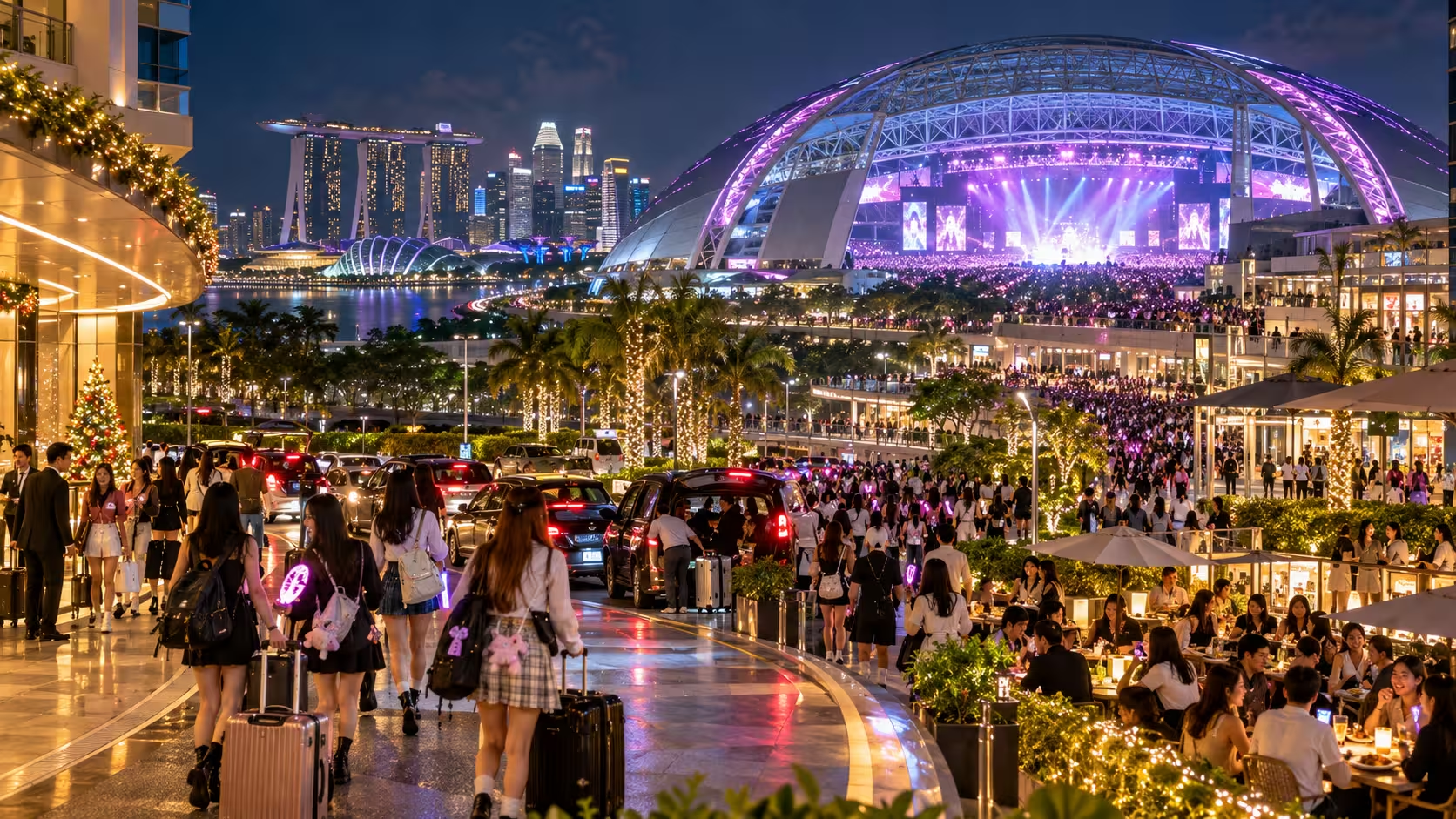
Singapore’s 2026 concert pipeline includes The Weeknd, BIGBANG, Guns N’ Roses, and BTS, alongside a deep bench of K-pop and regional acts. Each major tour stop generates a predictable demand shock across hospitality, aviation, retail, and F&B. The BTS December residency alone has already driven hotel bookings up more than 18-fold on Trip.com and a 103 percent increase in accommodation searches on Booking.com. These are not marginal fluctuations—they are structural demand events that venues, hotels, and transport providers can plan around.
Venue Expansion as a Growth Multiplier
The market’s growth trajectory is supported by deliberate infrastructure investment. Apex @ EXPO, a 9,000-capacity arena, opens to address the mid-tier touring gap. Live Nation’s 3,000-capacity Grange Road venue targets intimate shows and community events. The National Stadium at The Kallang continues to anchor the mega-tour segment. This layered ecosystem means Singapore can host multiple touring productions simultaneously—a capability that larger markets often lack due to venue concentration.
The K-Pop Demand Engine
K-pop remains the single most powerful demand driver in Singapore’s live entertainment market. Ticketmaster listings for K-pop events in Singapore rose approximately 250 percent between 2022 and 2024. The STB has explicitly framed K-pop as a tourism pillar, and the BTS December residency is the largest test of that thesis to date. If the shows deliver even the lower S$200 million estimate, K-pop will have demonstrated that it can sustain year-end tourism demand during a period that historically softens.
The Experience Economy Tailwind
Singapore’s live entertainment growth is not occurring in isolation. The World Economic Forum projects the global live events and sports sector will grow by about 16 percent annually to reach US$2 trillion by 2030, driven largely by millennials and Gen Z. Singapore’s market growth rate of 5.47 percent may appear modest by comparison, but it reflects a mature, high-value market rather than a volume-driven one. The city-state captures more economic value per attendee than regional peers—a function of its tourism infrastructure, premium service sector, and international connectivity.
The Sustainable Growth Question
The 2026 concert boom raises a practical question: how much of this growth is cyclical versus structural? The answer lies in the venue pipeline. Apex @ EXPO, the Grange Road venue, and The Kallang’s expanded programming calendar are not one-off responses to a hot market. They are long-term infrastructure bets that assume concert tourism will remain a permanent feature of Singapore’s visitor economy. The market’s projected trajectory to US$2.08 billion by 2034 suggests the industry agrees.