The Policeman in Shorts: A Forgotten Precedent
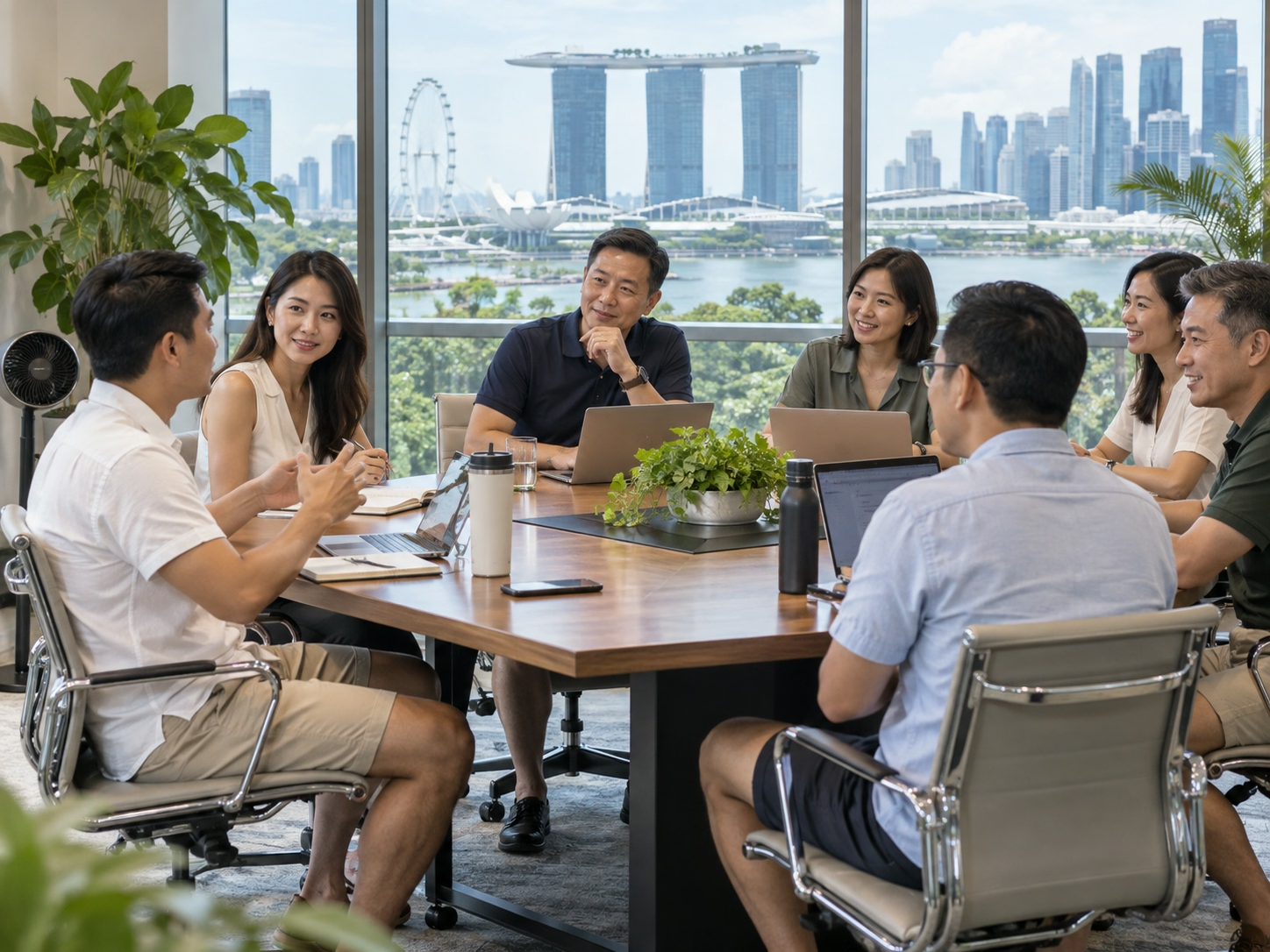
Singapore’s current embrace of climate-appropriate office attire is not unprecedented. In the years following independence, Singapore police officers wore knee-length khaki shorts while on duty—a practical adaptation to the tropical climate that persisted until 1 June 1969, when the force switched to dark blue trousers. That change was not driven by comfort but by the desire to project a more formal, internationally recognisable law enforcement image.
The episode illustrates a recurring tension in Singapore’s workwear history: the pull of climate realism versus the pull of global professional conventions. For much of the twentieth century, the latter won.
The Tailor-Made Era and Its Decline
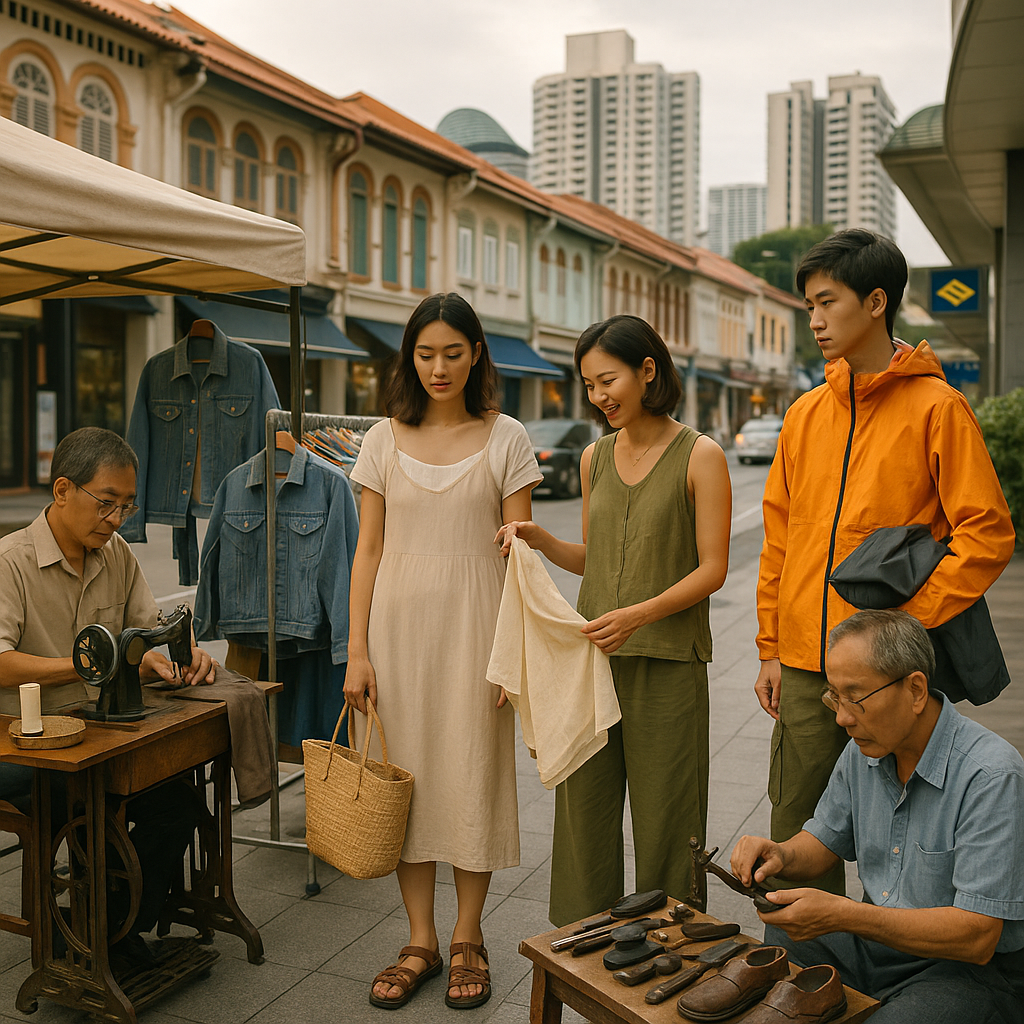
The mass adoption of tailor-made shirts and trousers for everyday wear, along with the suit for formal occasions, likely began in the 1920s. The rubber boom of that decade created disposable income for Singapore’s growing mercantile class, and Chinatown’s tailor street became the epicentre of sartorial production. Bespoke clothing was not a luxury; it was the standard.
This began to change in the 1970s and 1980s, when mass-produced garments from global brands flooded Singapore’s department stores. Tailor-made clothing, once the default, became a niche service for those who could afford it. The ready-to-wear suit—cut for temperate climates and produced at scale—became the uniform of corporate Singapore.
Air Conditioning and the Western Suit
The historian’s observation is blunt: air conditioning removed the logic for climate-appropriate dress and facilitated the introduction of the Western business suit. In thousands of offices across Asia, the standard business attire for both men and women became the dark-coloured suit made from heavy cotton or wool, paired with polyester shirts and ties more suitable to temperate climes. Despite the year-round temperatures of cities like Singapore and Kuala Lumpur, the suit persisted because air conditioning made it bearable.
This is the historical context that makes the Go 25 movement so significant. It is not simply a response to climate change. It is a correction of a seventy-year aberration in which Singapore’s offices were artificially cooled to accommodate clothing designed for other latitudes.
The Millennial Inflection Point
The first cracks in the suit’s dominance appeared in the 2010s. A Her World article from 2017 noted that Singapore’s corporate uniform had begun to evolve toward comfort, driven largely by millennials who championed individual expression. Industry observers traced the shift to the explosion of the tech and startup scene two to three years earlier, which normalised casual attire as a marker of innovative culture rather than professional negligence.
That inflection point has now accelerated into the mainstream. The SGBC’s 2026 attire guide, with its recommendations for linen, Tencel, and relaxed silhouettes, represents the institutional codification of a trend that began organically among younger workers.
The Return of the Tailor, Reimagined
Today’s sustainable tailoring movement in Singapore is not a nostalgic return to the 1920s. It is a synthesis. Contemporary tailors like CYC and Colony Clothing are combining bespoke fit with technical fabrics, unstructured constructions, and climate-appropriate design. The overshirt, the unlined jacket, and the knitted polo are not compromises between formality and comfort—they are new categories that resolve the tension entirely.
The century-long arc of Singapore’s workwear evolution—from khaki shorts to wool suits to sustainable tailoring—is ultimately a story about a city learning to dress for itself. The blazer is not disappearing. It is being reengineered for the climate in which it is worn, by tailors who understand that professionalism and breathability are not mutually exclusive.