Singapore’s cultural appeal extends far beyond entertainment and architecture. The city has cultivated a sophisticated art ecosystem where major museums, specialized heritage institutions, and contemporary galleries coexist in meaningful ways. For travelers, students, researchers, or collectors, exploring Singapore’s exhibitions provides a valuable introduction to Southeast Asian history, multicultural identity, and current artistic innovation.
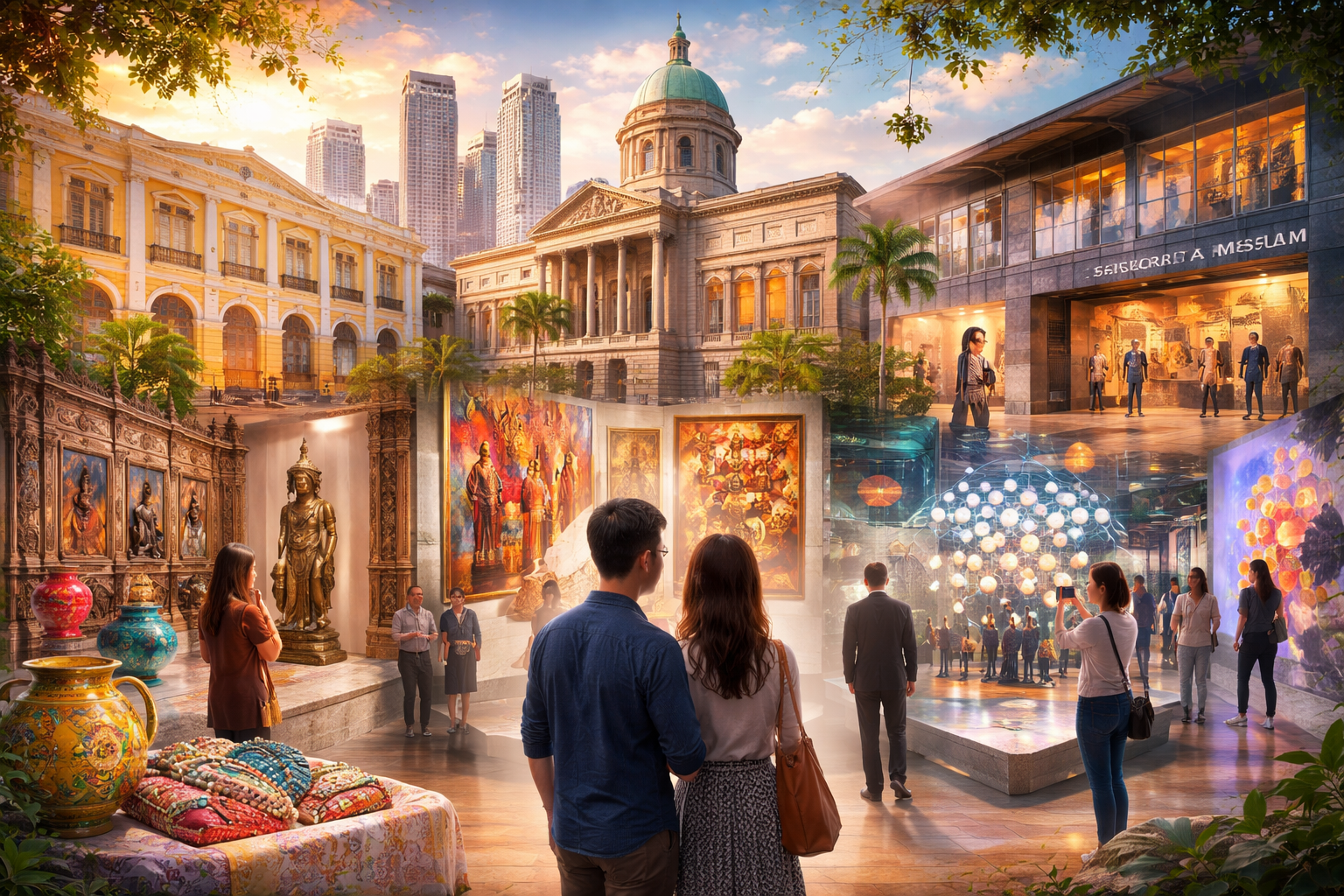
At the center of this experience is the National Gallery Singapore, a museum that has become one of Asia’s most respected visual arts institutions. Its importance lies not only in the size of its collection, but also in its focus on Singaporean and Southeast Asian modern art. The exhibitions offer a layered understanding of how artists have interpreted colonial rule, independence movements, modernization, and the complexities of belonging in fast-changing societies. Visitors often discover that the art presented here is deeply tied to questions of language, memory, migration, and public life. The setting enhances the visit as well. Because the museum occupies historic civic buildings, the architecture itself contributes to the narrative of national transformation.
The Singapore Art Museum provides a very different but equally important perspective. It is especially valuable for understanding how artists in Asia engage with contemporary issues through unconventional forms. Many of its exhibitions feature installation art, moving-image works, digital experiments, and collaborative projects that challenge the boundary between artwork and audience. This museum is ideal for visitors who enjoy reflective and sometimes provocative art. The themes explored in its exhibitions often include environmental crisis, surveillance, urban pressure, and social inequality, which gives the institution a strong relevance to present-day life.
A visit to the Asian Civilisations Museum deepens that journey by situating Singapore within larger Asian networks. The museum’s collections demonstrate that art has long been shaped by trade, religion, diplomacy, and migration. Its displays include sculptures, ceramics, manuscripts, sacred objects, and luxury goods that traveled across regions and influenced one another. This broader perspective helps visitors appreciate why Singapore’s own artistic identity is so diverse. The museum is particularly useful for those who want historical grounding before exploring more contemporary venues.
The Peranakan Museum is another essential stop because it presents a more intimate and community-based form of artistic heritage. Through carefully curated exhibitions, visitors encounter the visual richness of Peranakan culture, expressed in textiles, embroidery, beadwork, furniture, porcelain, and ceremonial dress. These objects reveal how aesthetic sensibility is woven into domestic life, family rituals, and social prestige. The museum is highly informative because it connects artistic beauty with cultural meaning, making it especially appealing to those interested in design, anthropology, and heritage studies.
For a sense of the city’s current contemporary art energy, Gillman Barracks should be included in any itinerary. This arts enclave houses several galleries that present rotating exhibitions by local, regional, and international artists. The works shown here are often experimental and globally engaged, covering photography, conceptual art, painting, sculpture, and multimedia practice. Because it is a gallery cluster rather than a single institution, it allows visitors to compare different curatorial voices and discover how commercial spaces contribute to artistic discourse.
What makes Singapore an exceptional place for art viewing is the way these institutions complement one another. The large museums provide historical and intellectual depth, while the galleries offer immediacy and innovation. Together, they reveal a city that takes culture seriously and understands art as part of public life, not just private taste. For anyone who wants to experience art in a setting where regional heritage and global contemporary practice meet, Singapore stands out as a destination that is both accessible and profoundly enriching.