The Brand That Normalised Reworking Before It Had a Name
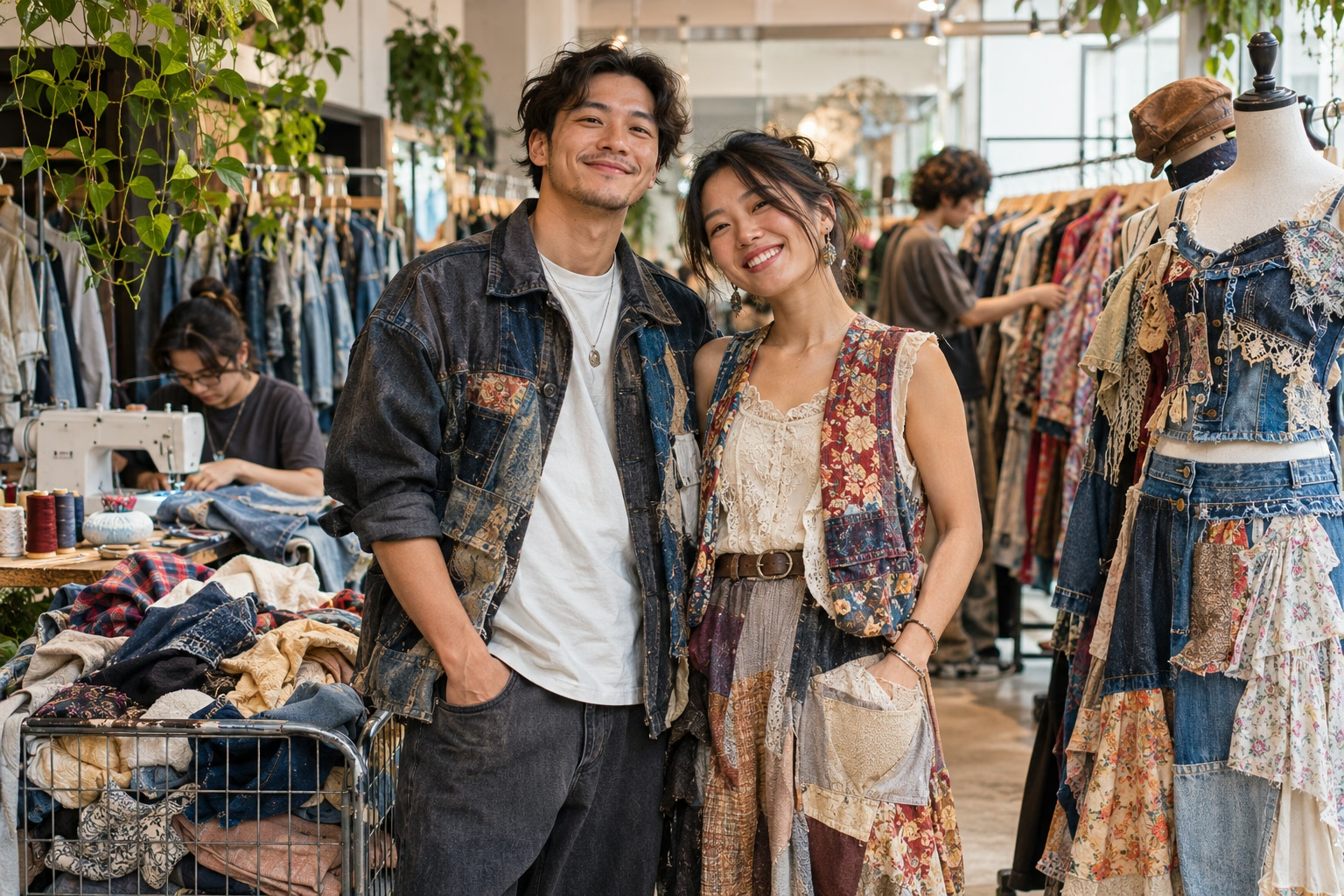
When Vintagewknd launched in 2015, “reworked fashion” was not yet a recognised category in Singapore’s retail vocabulary. The label, founded by couple Eden Tay and Eileen Tan, began with reworked and retro-inspired pieces at a time when sustainability in fashion was largely framed as a niche lifestyle choice. More than a decade later, Vintagewknd has upcycled over 60,000 kilograms of unwanted clothing items into new outfits — a cumulative figure that gives the brand a claim to pioneering status in Singapore’s circular fashion scene.
Style First, Sustainability as Consequence
Vintagewknd’s longevity offers a counterpoint to the assumption that reworked fashion must lead with an environmental message. The brand’s identity is built around trend-led, wearable pieces — reworked and retro-inspired clothing that competes on aesthetic terms first. Sustainability is the outcome, not the opening pitch. This sequencing matters in a market where consumer research consistently shows that style, fit, and price outrank ethical credentials at the point of purchase. By making reworked garments desirable rather than didactic, Vintagewknd has been able to reach buyers who might never seek out a “sustainable fashion” label.
The Operational Discipline Behind 60,000 Kilograms
Scaling reworked fashion is operationally difficult. Sourcing must be consistent, sorting must be systematic, and production must accommodate the variability of secondhand textiles. Vintagewknd’s decade-long accumulation of 60,000 kilograms upcycled implies a repeatable workflow rather than one-off artisanal batches. The brand also operates in the physical retail landscape, not only online — a signal that its products meet the fit-and-finish expectations of mainstream shoppers. For a sector often characterised by pop-ups and limited drops, that continuity is a different kind of proof point.
What a Decade of Reworking Teaches the Next Generation
Vintagewknd’s trajectory offers three lessons for Singapore’s newer reworked fashion entrants. First, consistency of aesthetic identity matters more than consistency of material: the brand’s look is recognisable even when the input garments vary. Second, consumer education can happen through product experience rather than pre-purchase messaging — a customer who buys a reworked piece for its style learns about circularity through ownership. Third, scale in reworking is not only about volume; it is about building a sourcing and production rhythm that can absorb the irregularity of donated and deadstock textiles without breaking the brand’s design language.
The Next Test: From Pioneer to Platform
Vintagewknd now operates in a more crowded field than it did in 2015. Sari upcyclers, kimono restorers, B2B reworking studios, and swap platforms have all entered the broader circular fashion space. The pioneer’s advantage is accumulated operational knowledge and brand recognition; the challenge is avoiding the fate of being categorised as “the original” while newer entrants capture the premium and heritage segments. How Vintagewknd positions itself — as a trend-driven reworking label, a circular fashion platform, or both — will shape whether its 60,000-kilogram milestone becomes a foundation for the next decade or a peak from which the brand must reinvent.