When a fashion brand disappears for seven years and then returns with a rule that would make most sourcing managers flinch, the market pays attention. In September 2026, Singapore label Aijek relaunched under founder Ong Wei Lin with a material policy that permits no polyester, no nylon, and no synthetic fibers of any kind. “You can’t have even 1% of polyester,” the founder told local media, describing a personal experiment in which she buried fabric samples in her father’s garden and found that only the synthetic blend remained after six months .
The policy is commercially risky. Aijek’s previous iteration, at its peak, operated 15 factories, generated nearly S$4 million in annual revenue, and sold through retailers including Anthropologie and Bloomingdale’s . The new version is deliberately smaller: production runs of fewer than 200 pieces per release, sold online and through a by-appointment home studio. The founder has abandoned lace, her former specialty, because it is typically made from polyester, and has instead worked with Balinese artisans practicing kerawang, a centuries-old cutwork embroidery technique.
The Authenticity Premium
Aijek’s bet is that a segment of consumers will pay for coherence. The brand’s previous chapter was not marketed as sustainable; it was simply fashion. The new chapter makes biodegradability the organizing principle. Every material choice, every artisan partnership, every production decision flows from that principle. The founder’s garden experiment—crude as it was—provided the evidentiary basis for the entire venture .
This approach contrasts with the incrementalism that characterizes much of the sustainable fashion sector. Many brands advertise “conscious” capsule collections while continuing to produce synthetics at volume. Aijek has chosen the opposite strategy: radical consistency at small scale. Whether the market rewards this depends on factors the brand cannot control—disposable income, consumer attention, and the gravitational pull of fast fashion’s low prices.
The Upcycling Alternative
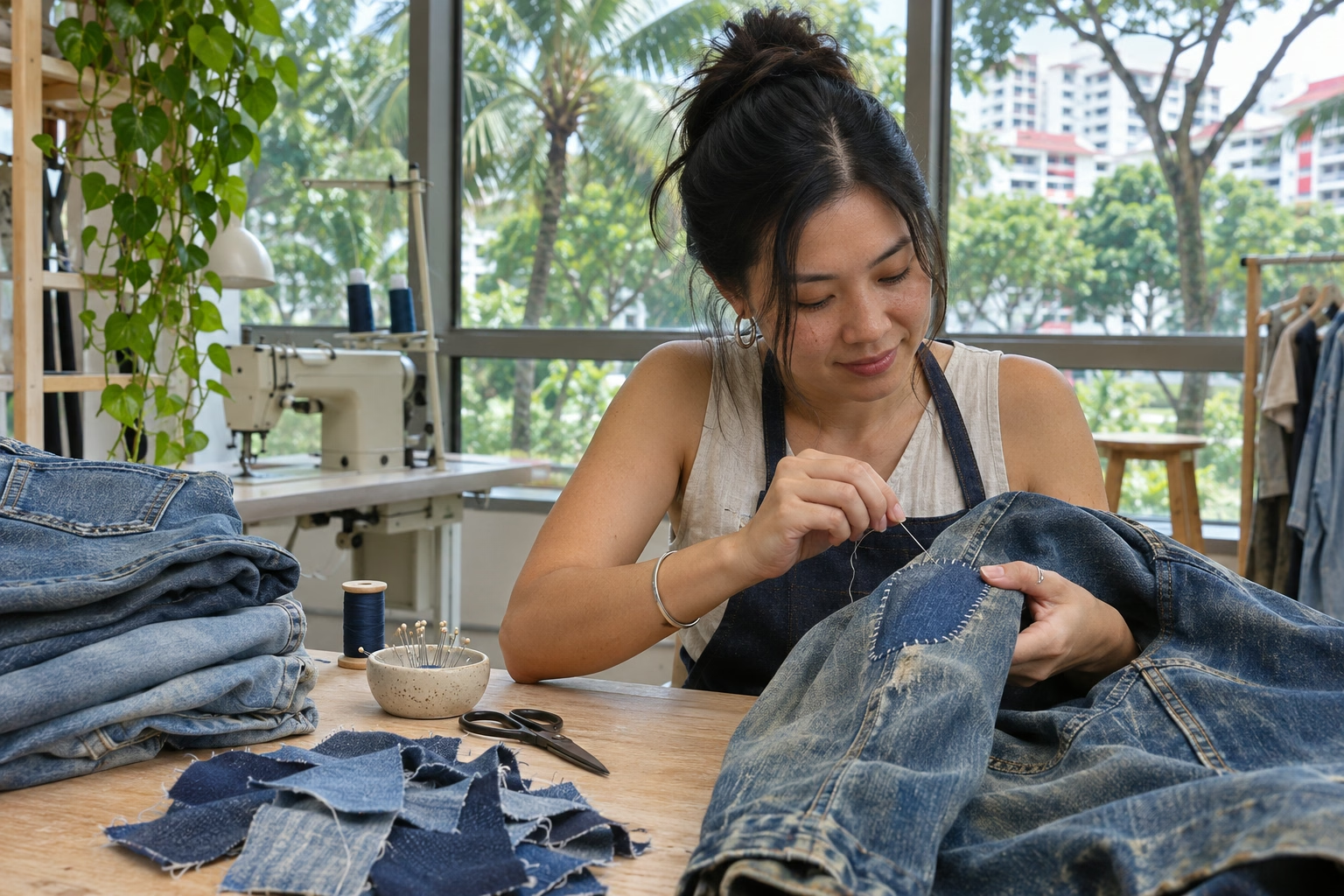
Aijek’s plant-based-only model represents one end of a spectrum of circular strategies emerging in Singapore. At the other end are upcycling ventures that make no material purity claims but extend the life of existing textiles. The Dori’s sari shirts, which sold at prices up to S$187, demonstrate that consumers will pay a premium for garments with a story—not necessarily a technical sustainability certification, but a visible provenance and a one-of-a-kind quality .
The two models are not competitors so much as different answers to the same question: what does sustainable fashion actually mean to the person buying it? For Aijek’s customer, it may mean a garment that can return to the soil. For The Dori’s customer, it may mean a shirt that preserves heritage and cannot be found anywhere else. Both represent a departure from the dominant sustainability messaging of the previous decade, which often emphasized certifications, recycled content percentages, and carbon offsets—metrics that are difficult for consumers to verify and easy for brands to manipulate.
The Scale Question Returns
The common constraint across both models is scale. Aijek’s production runs are tiny by design, reflecting the founder’s assessment that the brand cannot achieve its material standards at volume . The Dori’s supply of saris is finite, dependent on donations from a specific diaspora community. Neither business is positioned to replace fast fashion. Both are positioned to offer an alternative to consumers who have already opted out of it.
This is not a criticism. Small-scale models can be profitable, influential, and culturally significant. But the environmental math is unforgiving. Singapore’s textile waste problem will not be solved by boutiques selling fewer than 200 pieces per season. It will be solved—if at all—by changes in the mass market: better materials at accessible prices, collection systems that capture waste at scale, and policy that makes linear production economically unviable.
What the Consumer Actually Wants
The deeper uncertainty facing Aijek and its peers is whether consumers want what they say they want. Surveys consistently show strong stated preference for sustainable products. Sales data consistently show price sensitivity winning out. The brands that succeed in 2026 and beyond will be those that close this gap—by making sustainable choices convenient, by making them visually desirable, and by pricing them within reach of consumers who are not already committed to the cause.
Aijek’s founder acknowledged the difficulty of returning to a market transformed by social media and rapid trend cycles. “My previous approach, centered on focusing solely on products and attending trade shows, is, by her own admission, outdated,” the media report noted . She is now learning the rules of a landscape where visibility is mediated by algorithms and attention is the scarcest resource.
The comeback will be watched closely, not because Aijek alone determines the fate of Singapore’s eco-fashion sector, but because it tests a proposition that many brands are quietly evaluating: in a market where greenwashing has eroded trust, does uncompromising authenticity sell? The answer, whatever it turns out to be, will shape the strategies of the next wave of sustainable fashion ventures in Singapore.