Fermentation in Singapore is often narrated from the top down: Michelin kitchens, foodtech labs, market reports. But a parallel, quieter infrastructure is growing at the bottom — in workshop studios, community clubs and small-batch breweries where Singaporeans are learning to handle koji, brew sake and ferment their own chilli pastes. This is where the culture becomes a practice rather than a menu description.
Sake, koji and the amateur brewer
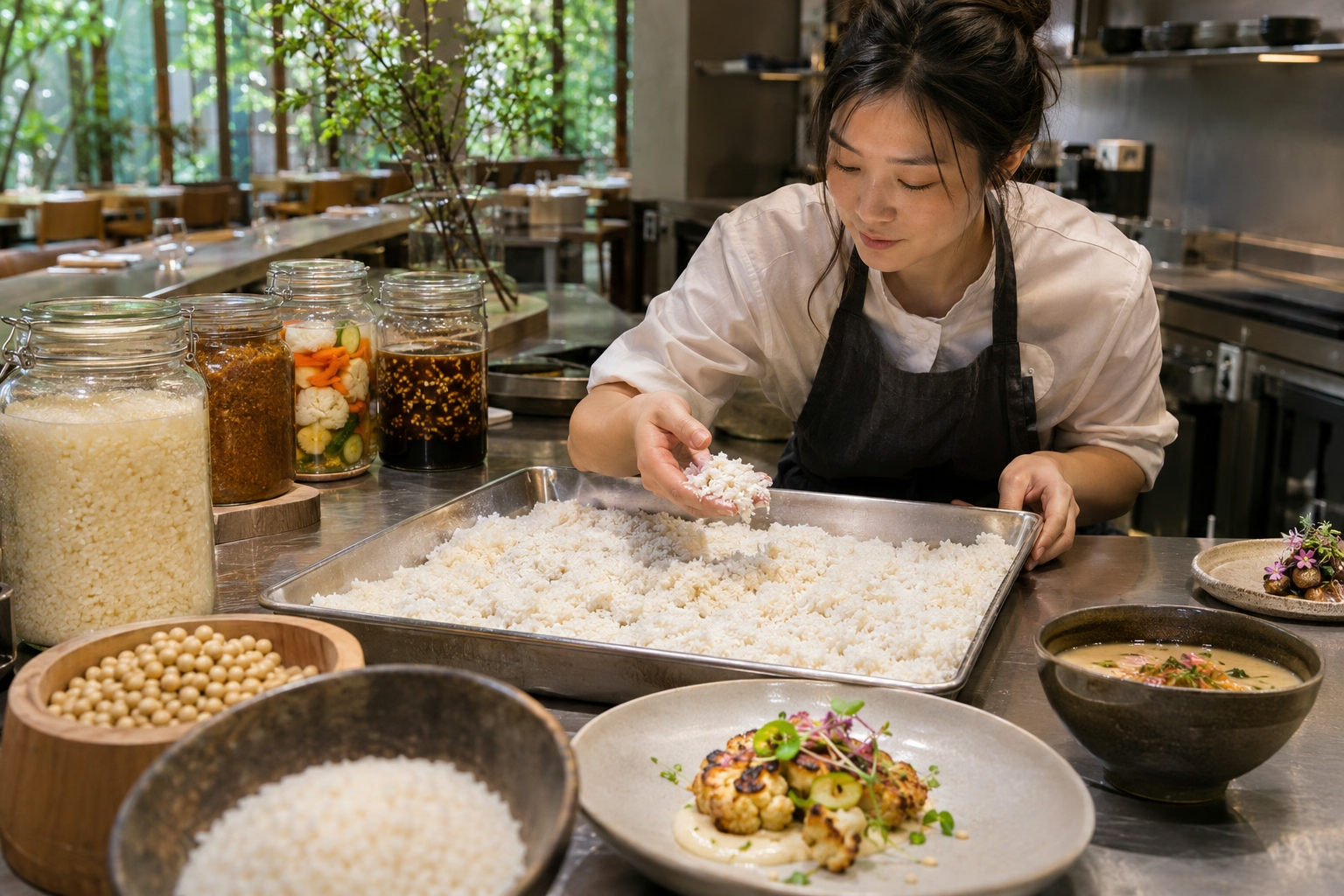
In Jurong West, Orchid Sake Brewery runs monthly sake-making workshops — a striking development for a city-state with no long sake-brewing tradition. The founders, Reuben Luke and Yumika Yamamoto, started Singapore’s first and only sake brewery in 2024, and their workshops teach participants to brew from scratch, with koji making at the centre of the process. The brewery also runs small-group trips through Japan built around breweries, koji spore houses, and miso and mirin makers — a sign that the interest is deep enough to support travel-scale learning.
The significance is not that every participant will open a brewery. It is that koji handling — temperature control, inoculation, enzyme development — is becoming a transferable skill rather than a trade secret. A home cook who has steamed rice and watched it bloom with white mycelium has a different relationship to a bowl of miso soup than one who buys a tub at the supermarket.
The workshop layer
Beyond sake, a broader fermentation workshop ecosystem has taken shape. SkillsFuture lists food-fermentation courses covering the fundamentals of food microbiology, traditional kimchi fermentation and kombucha brewing, with modules on food safety and troubleshooting. Community-centre programmes teach kombucha and yoghurt making for gut health, and eco-enzyme fermentation workshops turn fruit scraps into cleaning solutions. A two-hour “Ferment Your Own Foods” class at a commercial studio introduces anaerobic bacteria, temperature control and the SCOBY logic behind kombucha brewing.
These are not gourmet extras. They are literacy programmes for a food culture that is increasingly fermentation-literate at the restaurant level but still catching up at home. The gap matters: a diner who has made kimchi understands why unpasteurised kimchi tastes different from the pasteurised version; a home cook who has fermented chilli paste understands why belacan needs toasting.
The home-kitchen bridge
The commercial consequences are already visible. Fermenter, a Singapore business, hand-crafts tempeh, vegan cheeses, kombucha and koji from a fully plant-based perspective — a model that only makes sense in a market where enough home cooks and small kitchens understand what live-culture fermentation is. Meanwhile, the same koji and miso techniques that anchor Wakamama’s vegan omakase are becoming teachable skills through the workshop layer.
The result is a two-way street. Fine dining normalises fermentation as a serious craft; workshops give home cooks the vocabulary and technique to try it themselves; and a new generation of small businesses sells the starters, cultures and finished ferments that connect the two. The culture does not stay in the restaurant. It moves into the kitchen.