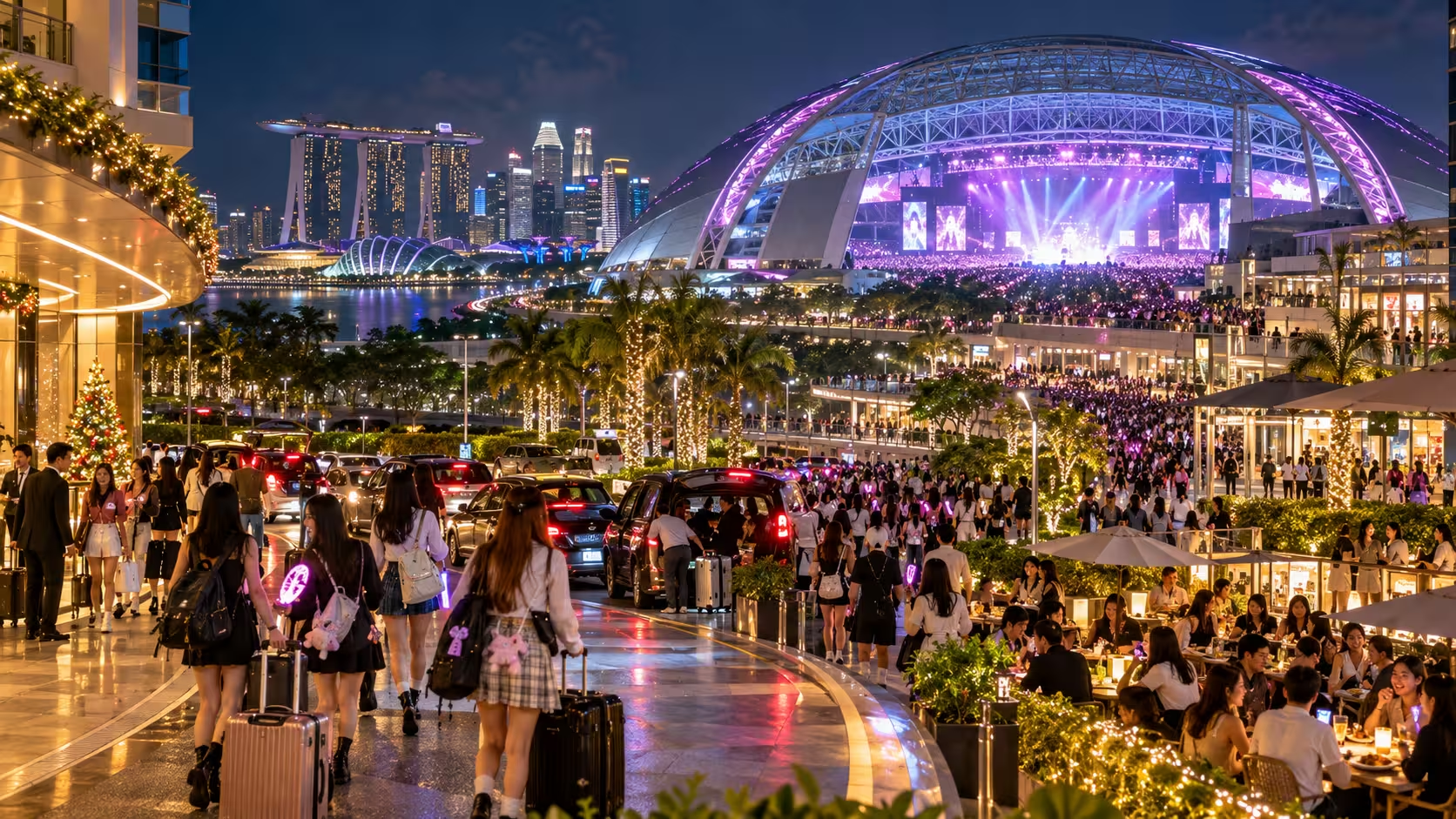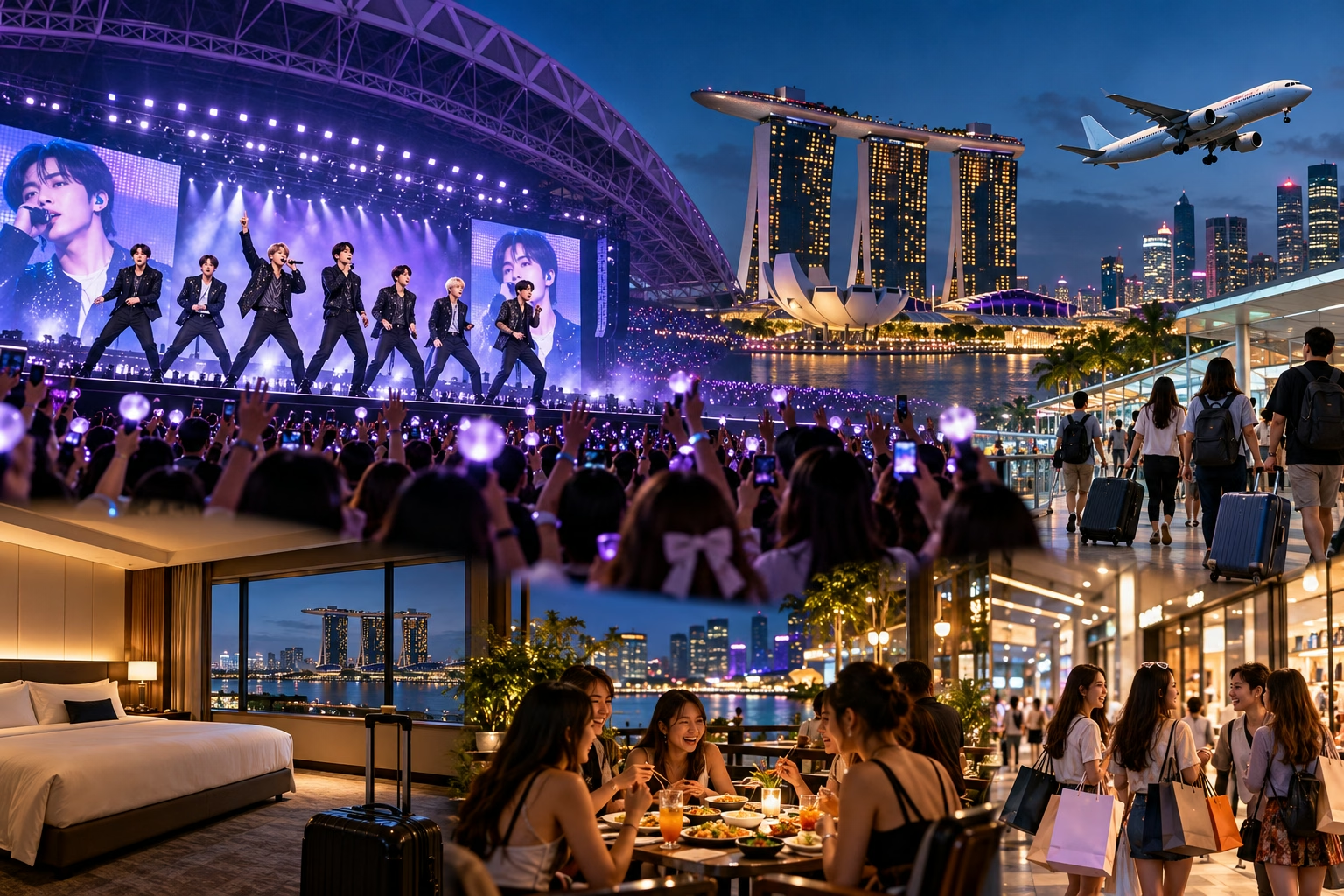
The concert is temporary. The strategic question is what remains after the stage is dismantled. Singapore’s answer, visible across its 2026 programming, is to treat exclusive concerts not as isolated events but as entry points into a longer-term cultural and economic relationship with artists, fandoms and the broader live-entertainment industry. The Singapore Tourism Board’s partnership with HYBE, the company behind BTS, has moved beyond a single tour stop into a multi-year collaboration that includes destination marketing, fan experiences and, according to Business Times, a K-pop training academy as part of a longer-term push to reinforce Singapore’s position as a regional entertainment hub .
From Event Host to Ecosystem Builder
The academy dimension is significant because it shifts the conversation from consumption to capability. SM Entertainment launched SM Universe Singapore, its first training academy outside South Korea, and by March 2025 it had announced plans to locate Southeast Asia’s first K-pop training academy at *SCAPE, Singapore’s youth-oriented arts hub . These investments do not generate the same headline numbers as a stadium residency, but they create a different kind of stickiness: a local talent pipeline, industry relationships and a cultural association that outlasts any single tour cycle.
The Calendar as a Strategic Asset
Singapore’s event calendar is also becoming an instrument of long-term positioning. Event organisers report that the 2026 calendar is filling up rapidly, with some events booked as far as two years in advance. That forward visibility allows hotels, airlines and venue operators to plan capacity and marketing around a predictable pipeline of demand rather than treating each concert as a surprise. The December 2026 BTS programme illustrates how a single residency can be stretched into a month-long tourism proposition: the concerts run on 17, 19, 20 and 22 December, but the surrounding BTS THE CITY ARIRANG SINGAPORE programme runs from 1 to 31 December, with themed events and installations across multiple city precincts .
The Soft-Power Calculation
Singapore’s bet on K-pop is explicitly framed as a soft-power play. Rather than viewing K-pop as a direct revenue stream, the city-state is leveraging the Korean Wave to strengthen its experience economy and brand appeal while benefiting from downstream tourism spending . Wong King Yin, a senior marketing lecturer at Nanyang Technological University, argues that K-pop reinforces Singapore’s stance as a vibrant lifestyle and entertainment hub—a branding outcome that is difficult to quantify but strategically valuable . The risk is that soft power is contingent on continued cultural relevance. If the K-pop touring cycle shifts decisively toward other regional hubs, or if fan preferences change, the branding dividend could weaken faster than the infrastructure investment can be redeployed.
The Unfinished Question: Permanence or Dependence?
The live-entertainment market’s growth trajectory supports the long-game thesis: Singapore’s market is forecast to grow from USD 1.29 billion in 2025 to USD 2.08 billion by 2034, with music concerts already the largest event segment . But the exclusivity model that has accelerated that growth is inherently contested. Malaysia’s incentive regime, Thailand’s festival packaging and the broader regional rush to capture concert tourism mean that Singapore cannot assume its current advantage will hold indefinitely . The long game, therefore, is not simply about winning more exclusive shows. It is about building a cultural infrastructure—venues, workforce, artist relationships, fan communities and year-round programming—that makes Singapore the most natural home for live entertainment in the region, whether or not any single artist grants it exclusivity.